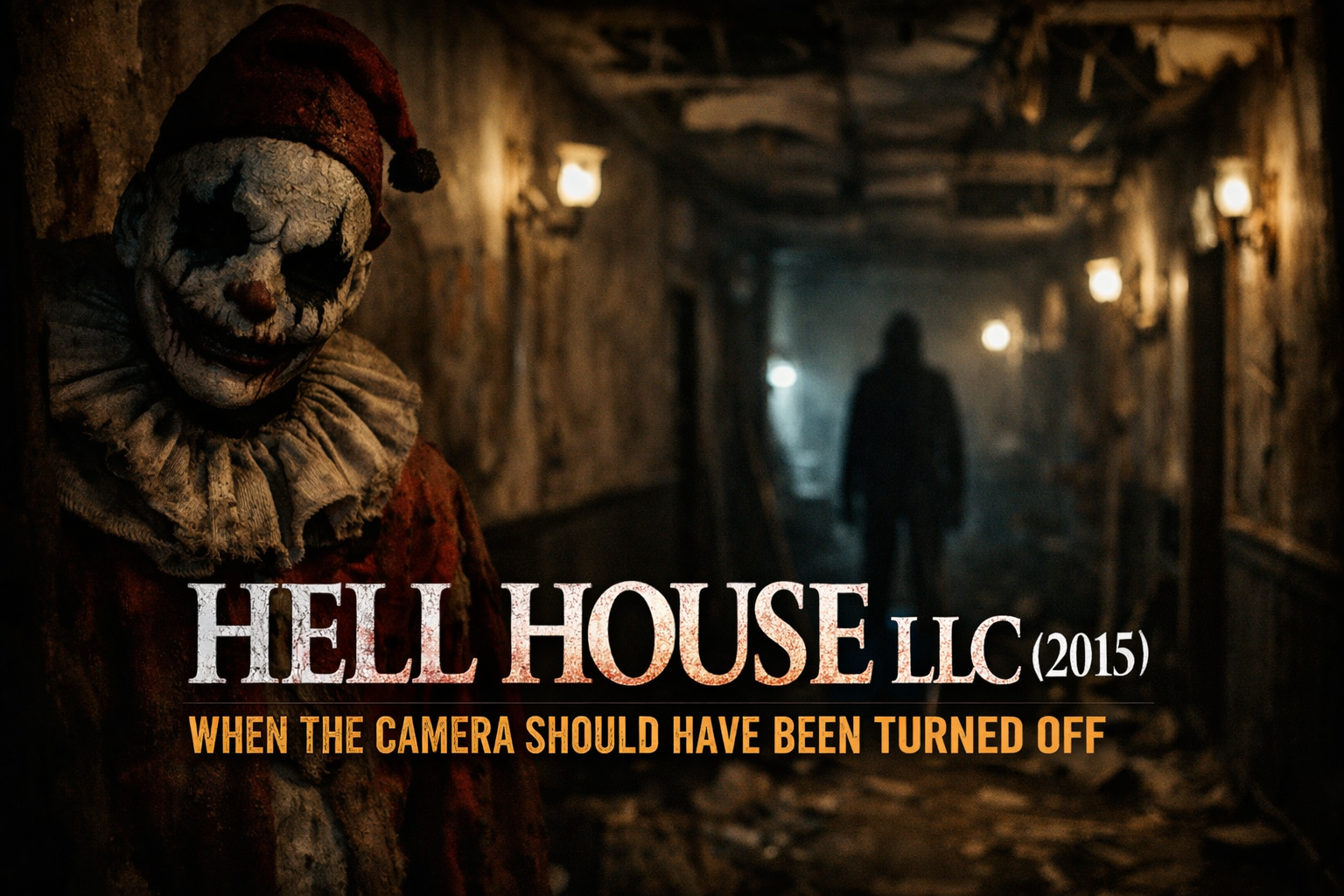
There are found footage films that shout for attention, and there are those that whisper until the silence becomes unbearable. Hell House LLC belongs firmly to the latter. Released quietly in 2015, Stephen Cognetti’s film earned its reputation not through spectacle, but through accumulation—of unease, implication, and the creeping sense that something has already gone irreversibly wrong. It is a film that trusts the viewer to listen closely, to watch the corners of the frame, and to recognize dread before it announces itself.
Within the crowded landscape of found footage horror, Hell House LLC distinguishes itself by rejecting chaos in favor of structure. It adopts the language of documentary and investigative journalism, presenting itself as an assembled record of a tragedy whose meaning remains incomplete. The result is not merely a haunted house story, but a meditation on belief—what we invite in, what we ignore, and what happens when curiosity outpaces caution. Any serious Hell House LLC review must contend with this restraint, because it is precisely what makes the film linger.
At its core, the film is preoccupied with thresholds: between skepticism and faith, performance and ritual, technology and the unknowable. Cameras meant to capture a commercial spectacle instead document a slow erosion of certainty. The horror does not arrive all at once. It seeps in, patient and methodical, until the footage itself feels contaminated.
Plot Overview (Concise)
Hell House LLC is framed as a documentary examining the unexplained deaths that occurred during the opening night of a Halloween haunted house attraction in rural New York. The attraction was created by a small group of friends operating under the name Hell House LLC, who moved their operation into the abandoned Abaddon Hotel despite local warnings and troubling rumors.
The film alternates between interviews conducted years after the incident and recovered footage filmed during the setup and operation of the haunted house. Presented as evidence rather than spectacle, the material is deliberately plain, emphasizing realism and routine. What unfolds is not a traditional narrative escalation, but a gradual disruption of the ordinary, captured incidentally by cameras that were never meant to document anything beyond rehearsals and pranks.
Horror Style & Themes
The fear in Hell House LLC is built through subtraction rather than excess. Sound design is sparse, often dominated by ambient noise or the hum of empty rooms. When something intrudes—a voice where there should be none, a figure standing too still—it does so without emphasis. The camera rarely reacts in time, and that delay becomes its own source of terror. The viewer is left to notice, to question, and to dread what might appear again.
Thematically, the film draws heavily from religious and cosmic horror traditions without fully committing to explicit theology. Symbols of faith are present but distorted, stripped of comfort and certainty. What emerges is a worldview in which belief itself is dangerous—not because it is false, but because it opens doors that cannot be closed. The Abaddon Hotel functions less as a haunted space than as a conduit, a place where intention and ritual have left a residue.
There is also a quiet nihilism at work. The characters’ casual dismissal of early warning signs is not framed as stupidity, but as familiarity. They believe they are in control because they have seen haunted houses before. This assumption—that horror can be staged, managed, and monetized—becomes the film’s most damning critique. In this sense, Hell House LLC operates as a found footage haunted house movie that interrogates the genre from within.
Found Footage Effectiveness
The found footage format is essential to the film’s power because it enforces limits. The camera does not chase the horror; it stumbles upon it. Many of the most unsettling moments occur at the edge of the frame or in the background, half-seen and easily missed. This forces the viewer into an active role, scanning the image for inconsistencies, learning to distrust what appears stable.
Authenticity is further reinforced by the film’s refusal to polish its material. Conversations overlap, scenes linger too long, and nothing feels staged for maximum effect. The footage feels recovered rather than curated. In a subgenre often undermined by contrivance, Hell House LLC understands that plausibility is the foundation of fear. The camera is not a weapon or a shield—it is simply there, and that indifference makes it complicit.
Ending Explained — The Meaning Behind the Final Descent
The ending of Hell House LLC resists closure, and that resistance is deliberate. Rather than offering a definitive explanation for the events at the Abaddon Hotel, the film allows its final moments to collapse inward, folding revelation into ambiguity. What is shown suggests a ritual completed, a boundary crossed not through violence but through acquiescence.
Symbolically, the conclusion frames damnation as a process rather than an event. The characters are not punished for a single transgression; they are consumed by a pattern of choices rooted in denial and arrogance. The hotel does not attack so much as accept what has been offered to it—attention, belief, and presence. In this reading, the horror is cosmic rather than moral. There is no reckoning, only absorption.
By ending where it does, the film aligns itself with a tradition of existential horror in which understanding provides no escape. The footage survives, but the people do not, and the act of watching becomes its own uneasy continuation. The ending is not a twist, but a confirmation that the camera, once turned on, could never be turned off again.
Final Verdict / Why It Endures
Hell House LLC is not designed for viewers seeking catharsis or spectacle. It is for those who appreciate horror as an atmosphere that settles into the mind and refuses to leave. Its influence can be traced through contemporary discussions of the scariest found footage films, not because it reinvents the form, but because it respects it.
Years after its release, the film endures because it understands something fundamental: that the most unsettling horror does not announce itself. It waits. It watches. And long after the screen goes dark, it leaves you wondering whether some places, once observed, begin to observe in return.