Category: Uncategorized

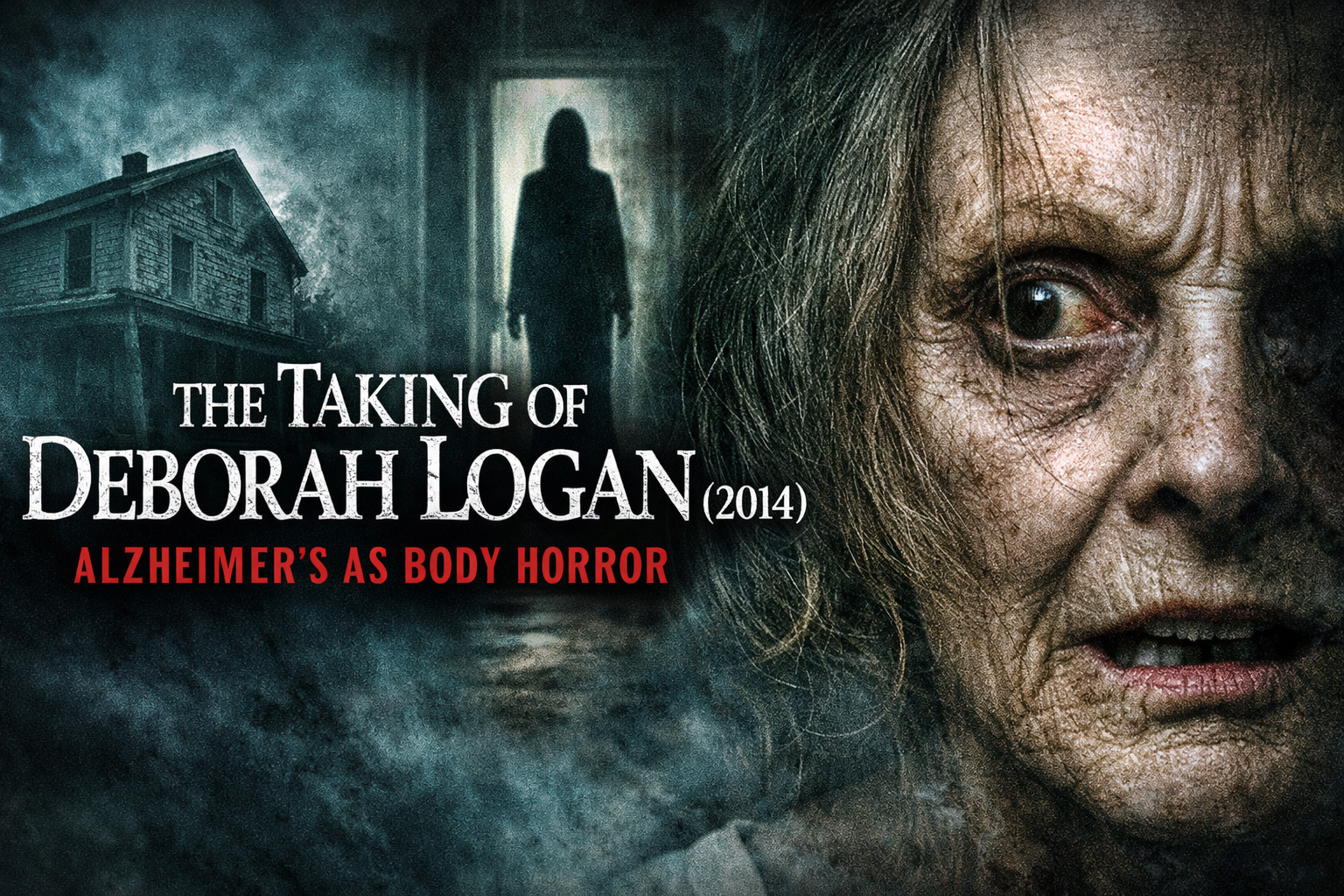
  • The Taking of Deborah Logan (2014) Review — Alzheimer’s as Body Horror

    The Taking of Deborah Logan (2014) Review — Alzheimer’s as Body Horror

    By the time The Taking of Deborah Logan appeared in 2014, found footage horror was already burdened with exhaustion. The form had been stretched thin by repetition and cheap escalation, its once-radical intimacy dulled by predictability. And yet, this film arrived quietly and stayed. It did not announce itself with spectacle or reinvention, but with patience—allowing dread to seep in through mundane observation, medical documentation, and the unglamorous terror of watching a mind erode.

    Often cited in discussions of underrated horror cinema, The Taking of Deborah Logan endures because it understands that true fear is not loud. It is procedural. It is incremental. It lives in the subtle betrayal of the body by the self, and in the suggestion that something ancient and unyielding may be waiting beneath familiar diagnoses. As a found footage horror film, it disguises its ambitions behind realism, only to reveal something far older and more malignant than its surface narrative suggests.

    At its core, this is a film about Alzheimer’s as body horror—about the fragility of identity and the terror of watching consciousness dissolve. But it is also a work of religious horror, steeped in questions of belief, inevitability, and the terror of discovering that faith arrives too late to be useful. This The Taking of Deborah Logan review examines why the film remains so effective years after its release, and why its quiet confidence continues to unsettle modern horror audiences.

    Plot Overview

    The film follows a small documentary crew granted access to Deborah Logan, an elderly woman diagnosed with Alzheimer’s disease, and her daughter Sarah, who has agreed to let the progression of the illness be filmed for academic purposes. The project is framed as a clinical study—observational, detached, and ostensibly humane.

    As filming continues, Deborah’s condition worsens in ways that strain medical explanation. The crew documents behavioral changes, memory loss, and disorientation, but also moments that suggest something less comprehensible at work. The narrative unfolds through interviews, night recordings, and observational footage, maintaining the illusion of a grounded, investigative documentary even as the boundaries between illness and intrusion begin to erode.

    The film avoids sensational plot turns in favor of accumulation. Each recorded moment builds upon the last, allowing the viewer to remain inside the process rather than outside it. The horror emerges not from surprise, but from recognition.

    Horror Style & Themes

    What distinguishes The Taking of Deborah Logan from many of its contemporaries is its restraint. Fear is constructed through absence as much as presence—through long stretches of quiet observation punctuated by moments of behavioral rupture. Sound design favors domestic ambience over orchestration. The camera lingers when it should look away. Silence becomes accusatory.

    Alzheimer’s is not treated as a metaphor lightly applied, but as an existential condition that mirrors the film’s deeper anxieties. Deborah’s deterioration reflects a broader horror: the loss of narrative coherence itself. As memory fails, time becomes unreliable. Identity fractures. The viewer is forced to confront a reality where continuity is not guaranteed, and where the self may simply disintegrate without meaning or closure.

    The film’s religious horror elements arrive gradually, rooted in the language of possession, ritual, and inherited guilt. Faith is not presented as salvation, but as a system struggling to impose order on something indifferent to human belief. This places the film at an intersection between psychological horror and cosmic horror, where ancient forces are less interested in humanity than in their own persistence.

    There is no comfort offered in diagnosis, nor in belief. Knowledge does not protect. Documentation does not save. The horror is not merely that something is happening to Deborah Logan, but that it may have always been waiting.

    Found Footage Effectiveness

    The found footage format is essential to the film’s impact because it enforces limitation. The camera does not intervene; it records. It cannot interpret, only observe. This creates an ethical tension that becomes increasingly uncomfortable as events escalate. The audience is implicated as a witness, complicit in the act of watching deterioration unfold for the sake of understanding.

    Authenticity is achieved not through chaos, but through procedure. Interviews are mundane. Equipment fails quietly. Conversations overlap. The footage feels less like a horror film and more like evidence, which lends the later developments an unsettling plausibility. The implication is not that the camera reveals truth, but that it captures fragments—never enough to prevent what is coming.

    In this way, The Taking of Deborah Logan uses found footage not as a gimmick, but as a philosophical constraint. Horror exists precisely because the format cannot offer omniscience or control.

    Ending Explained — Meaning, Symbolism, and Implications

    The ending of The Taking of Deborah Logan is often discussed for its shift in scale, but its true significance lies in culmination rather than surprise. What is revealed is not a narrative reversal, but a clarification: the personal horror of Deborah’s decline has always been tethered to something impersonal and ancient.

    Symbolically, the conclusion reframes Alzheimer’s not as a misdirection, but as a vulnerability—an opening through which something inhuman can assert itself. The film suggests that loss of self is not merely tragic, but dangerous. When identity erodes, it creates space for occupation, not redemption.

    From a cosmic horror perspective, the ending reinforces the idea that human suffering is incidental to larger forces. The rituals, the names, and the history uncovered near the film’s conclusion do not offer mastery over evil, only a vocabulary for its presence. Knowledge arrives too late, and faith is exposed as reactive rather than preventative.

    Rather than resolving fear, the ending removes illusion. It implies that horror is not an interruption of normality, but an extension of it—waiting patiently for weakness.

    Final Verdict / Why It Endures

    The Taking of Deborah Logan is a film for viewers who value atmosphere over excess, implication over spectacle. It speaks to horror fans drawn to found footage not for chaos, but for intimacy; to audiences unsettled by the slow violence of time and the unreliability of the self.

    Its legacy lies in its seriousness. The film does not mock belief, nor does it romanticize suffering. Instead, it presents horror as an inevitable convergence of biology, history, and indifference. In an era saturated with self-aware genre exercises, this film remains unsettling because it never winks.

    Long after the footage ends, what lingers is not the image of possession, but the quiet terror of watching a person disappear—knowing that something else may be waiting to take their place.
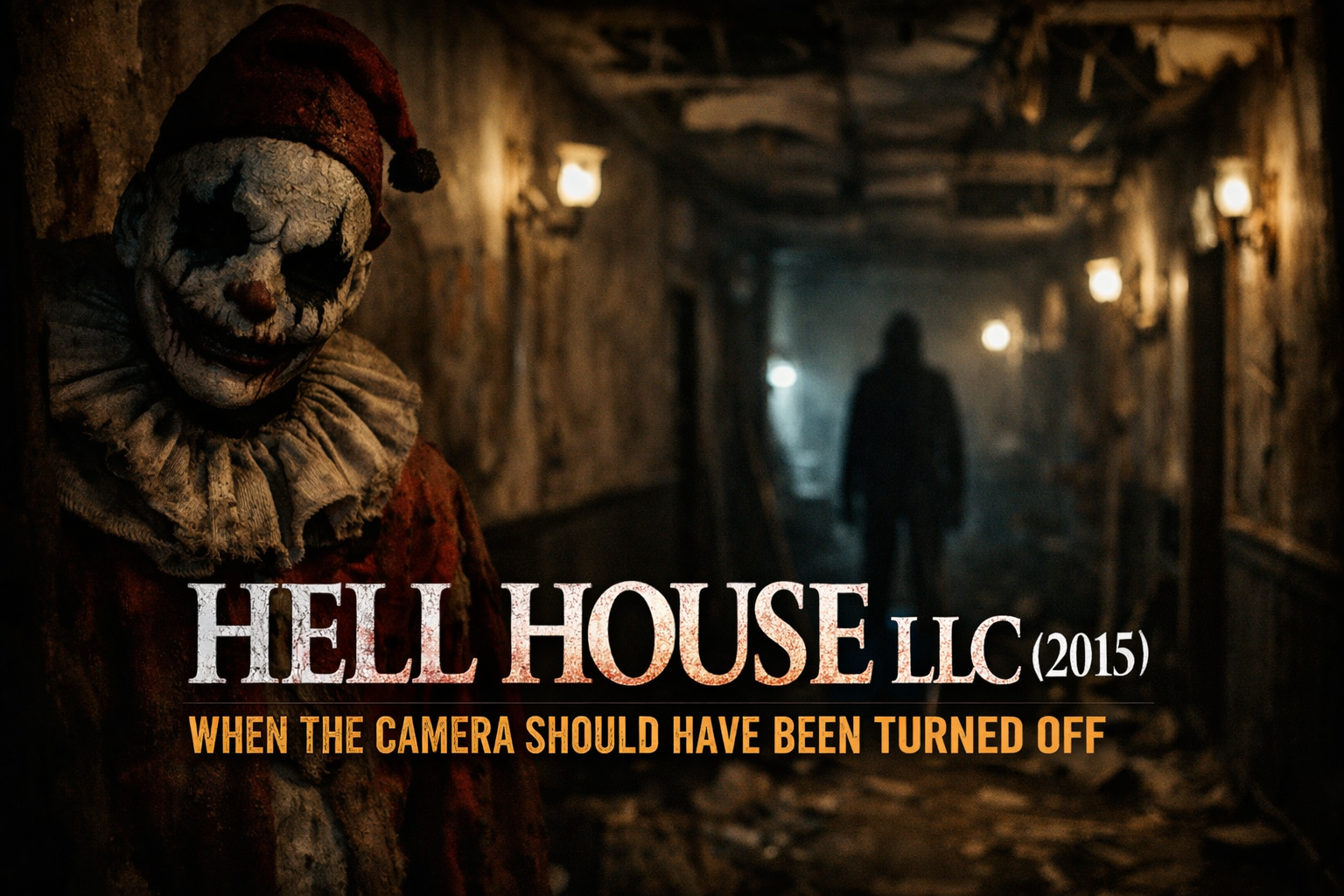
  • Hell House LLC (2015) — When the Camera Should Have Been Turned Off

    Hell House LLC (2015) — When the Camera Should Have Been Turned Off

    There are found footage films that shout for attention, and there are those that whisper until the silence becomes unbearable. Hell House LLC belongs firmly to the latter. Released quietly in 2015, Stephen Cognetti’s film earned its reputation not through spectacle, but through accumulation—of unease, implication, and the creeping sense that something has already gone irreversibly wrong. It is a film that trusts the viewer to listen closely, to watch the corners of the frame, and to recognize dread before it announces itself.

    Within the crowded landscape of found footage horror, Hell House LLC distinguishes itself by rejecting chaos in favor of structure. It adopts the language of documentary and investigative journalism, presenting itself as an assembled record of a tragedy whose meaning remains incomplete. The result is not merely a haunted house story, but a meditation on belief—what we invite in, what we ignore, and what happens when curiosity outpaces caution. Any serious Hell House LLC review must contend with this restraint, because it is precisely what makes the film linger.

    At its core, the film is preoccupied with thresholds: between skepticism and faith, performance and ritual, technology and the unknowable. Cameras meant to capture a commercial spectacle instead document a slow erosion of certainty. The horror does not arrive all at once. It seeps in, patient and methodical, until the footage itself feels contaminated.

    Plot Overview (Concise)

    Hell House LLC is framed as a documentary examining the unexplained deaths that occurred during the opening night of a Halloween haunted house attraction in rural New York. The attraction was created by a small group of friends operating under the name Hell House LLC, who moved their operation into the abandoned Abaddon Hotel despite local warnings and troubling rumors.

    The film alternates between interviews conducted years after the incident and recovered footage filmed during the setup and operation of the haunted house. Presented as evidence rather than spectacle, the material is deliberately plain, emphasizing realism and routine. What unfolds is not a traditional narrative escalation, but a gradual disruption of the ordinary, captured incidentally by cameras that were never meant to document anything beyond rehearsals and pranks.

    Horror Style & Themes

    The fear in Hell House LLC is built through subtraction rather than excess. Sound design is sparse, often dominated by ambient noise or the hum of empty rooms. When something intrudes—a voice where there should be none, a figure standing too still—it does so without emphasis. The camera rarely reacts in time, and that delay becomes its own source of terror. The viewer is left to notice, to question, and to dread what might appear again.

    Thematically, the film draws heavily from religious and cosmic horror traditions without fully committing to explicit theology. Symbols of faith are present but distorted, stripped of comfort and certainty. What emerges is a worldview in which belief itself is dangerous—not because it is false, but because it opens doors that cannot be closed. The Abaddon Hotel functions less as a haunted space than as a conduit, a place where intention and ritual have left a residue.

    There is also a quiet nihilism at work. The characters’ casual dismissal of early warning signs is not framed as stupidity, but as familiarity. They believe they are in control because they have seen haunted houses before. This assumption—that horror can be staged, managed, and monetized—becomes the film’s most damning critique. In this sense, Hell House LLC operates as a found footage haunted house movie that interrogates the genre from within.

    Found Footage Effectiveness

    The found footage format is essential to the film’s power because it enforces limits. The camera does not chase the horror; it stumbles upon it. Many of the most unsettling moments occur at the edge of the frame or in the background, half-seen and easily missed. This forces the viewer into an active role, scanning the image for inconsistencies, learning to distrust what appears stable.

    Authenticity is further reinforced by the film’s refusal to polish its material. Conversations overlap, scenes linger too long, and nothing feels staged for maximum effect. The footage feels recovered rather than curated. In a subgenre often undermined by contrivance, Hell House LLC understands that plausibility is the foundation of fear. The camera is not a weapon or a shield—it is simply there, and that indifference makes it complicit.

    Ending Explained — The Meaning Behind the Final Descent

    The ending of Hell House LLC resists closure, and that resistance is deliberate. Rather than offering a definitive explanation for the events at the Abaddon Hotel, the film allows its final moments to collapse inward, folding revelation into ambiguity. What is shown suggests a ritual completed, a boundary crossed not through violence but through acquiescence.

    Symbolically, the conclusion frames damnation as a process rather than an event. The characters are not punished for a single transgression; they are consumed by a pattern of choices rooted in denial and arrogance. The hotel does not attack so much as accept what has been offered to it—attention, belief, and presence. In this reading, the horror is cosmic rather than moral. There is no reckoning, only absorption.

    By ending where it does, the film aligns itself with a tradition of existential horror in which understanding provides no escape. The footage survives, but the people do not, and the act of watching becomes its own uneasy continuation. The ending is not a twist, but a confirmation that the camera, once turned on, could never be turned off again.

    Final Verdict / Why It Endures

    Hell House LLC is not designed for viewers seeking catharsis or spectacle. It is for those who appreciate horror as an atmosphere that settles into the mind and refuses to leave. Its influence can be traced through contemporary discussions of the scariest found footage films, not because it reinvents the form, but because it respects it.

    Years after its release, the film endures because it understands something fundamental: that the most unsettling horror does not announce itself. It waits. It watches. And long after the screen goes dark, it leaves you wondering whether some places, once observed, begin to observe in return.

  • The Borderlands (2013) Review — Faith, Folklore, and the Final 10 Minutes

    The Borderlands (2013) Review — Faith, Folklore, and the Final 10 Minutes

    The Borderlands (2013)—released in the U.S. as Final Prayer—is one of the most unsettling examples of religious found footage horror ever made. What begins as a restrained Vatican investigation slowly transforms into something far more ancient and nihilistic, culminating in an ending that has earned a reputation as one of the most disturbing in modern horror cinema.

    This is not a film that relies on jump scares or demonic theatrics. Instead, The Borderlands builds dread through atmosphere, sound design, and the quiet erosion of certainty. By the time viewers reach its infamous conclusion, the film has carefully dismantled both faith and skepticism—leaving only cosmic indifference behind.

    Plot Overview: A Vatican Investigation Gone Wrong

    The story follows a small team sent by the Catholic Church to investigate reports of miracles at a remote English church. Deacon, a devout believer, leads the mission alongside Gray, a hardened skeptic tasked with debunking supernatural claims. Their goal is simple: determine whether the site is truly holy or merely another case of superstition.

    Presented entirely through found footage—handheld cameras, audio recordings, and surveillance—the film adopts a documentary realism that makes every interaction feel authentic. Early scenes are dominated by technical malfunctions, strange acoustics, and subtle disturbances rather than overt paranormal activity. The horror arrives slowly, almost apologetically.

    Religious Horror Rooted in Atmosphere, Not Spectacle

    What sets The Borderlands apart from typical possession or exorcism films is its restraint. This is religious horror stripped of melodrama. The church is not immediately threatening, but it feels wrong. Sound behaves unnaturally. Space feels inconsistent. Silence stretches too long.

    Rather than depicting demons or divine intervention outright, the film suggests that something older than Christianity occupies the space. Religious symbols lose their meaning as the investigation continues, turning from sources of comfort into hollow gestures. Faith is not attacked—but it is rendered tragically insufficient.


    Found Footage as Slow-Burn Cosmic Horror

    As a found footage film, The Borderlands excels at implication. The cameras never show too much, forcing the audience to lean into shadows and distorted audio. This technique aligns the film closely with cosmic horror, where fear comes not from monsters, but from the realization that humanity does not matter.

    Both belief and disbelief fail the characters. Skepticism cannot explain what is happening, and faith cannot protect them from it. The film refuses to reward either worldview, allowing tension to build through uncertainty rather than revelation.

    The Borderlands Ending Explained: A Descent into Nihilism

    Any serious discussion of The Borderlands inevitably leads to its final ten minutes. Frequently searched as “The Borderlands ending explained,” the conclusion abandons conventional horror logic entirely.

    The church is revealed not as a sacred site, but as something alive—an ancient organism mistaken for a holy place. Stone corridors give way to organic darkness. The structure itself consumes the characters, suggesting that centuries of worship were misdirected toward a predatory force that predates religion.

    There is no God waiting at the end. No demon to banish. No meaning to uncover.

    This is pure cosmic horror: the terrifying idea that humanity has built belief systems around something that does not care, does not listen, and does not distinguish prayer from screaming. The universe presented in The Borderlands is not evil—it is indifferent.

    Why The Borderlands Is One of the Most Disturbing Found Footage Films

    Unlike many horror films that resolve their mysteries, The Borderlands ends by erasing the very concept of resolution. Its final moments retroactively poison everything that came before, transforming a religious investigation into a fatal misunderstanding on a cosmic scale.

    For viewers seeking:

    • Religious found footage horror
    • Cosmic horror films with bleak endings
    • Horror that prioritizes existential dread over shocks

    The Borderlands remains essential viewing.

    It does not offer fear as entertainment.
    It offers fear as revelation.

    And once you see what waits beneath the church, it’s impossible to believe in silence the same way again.