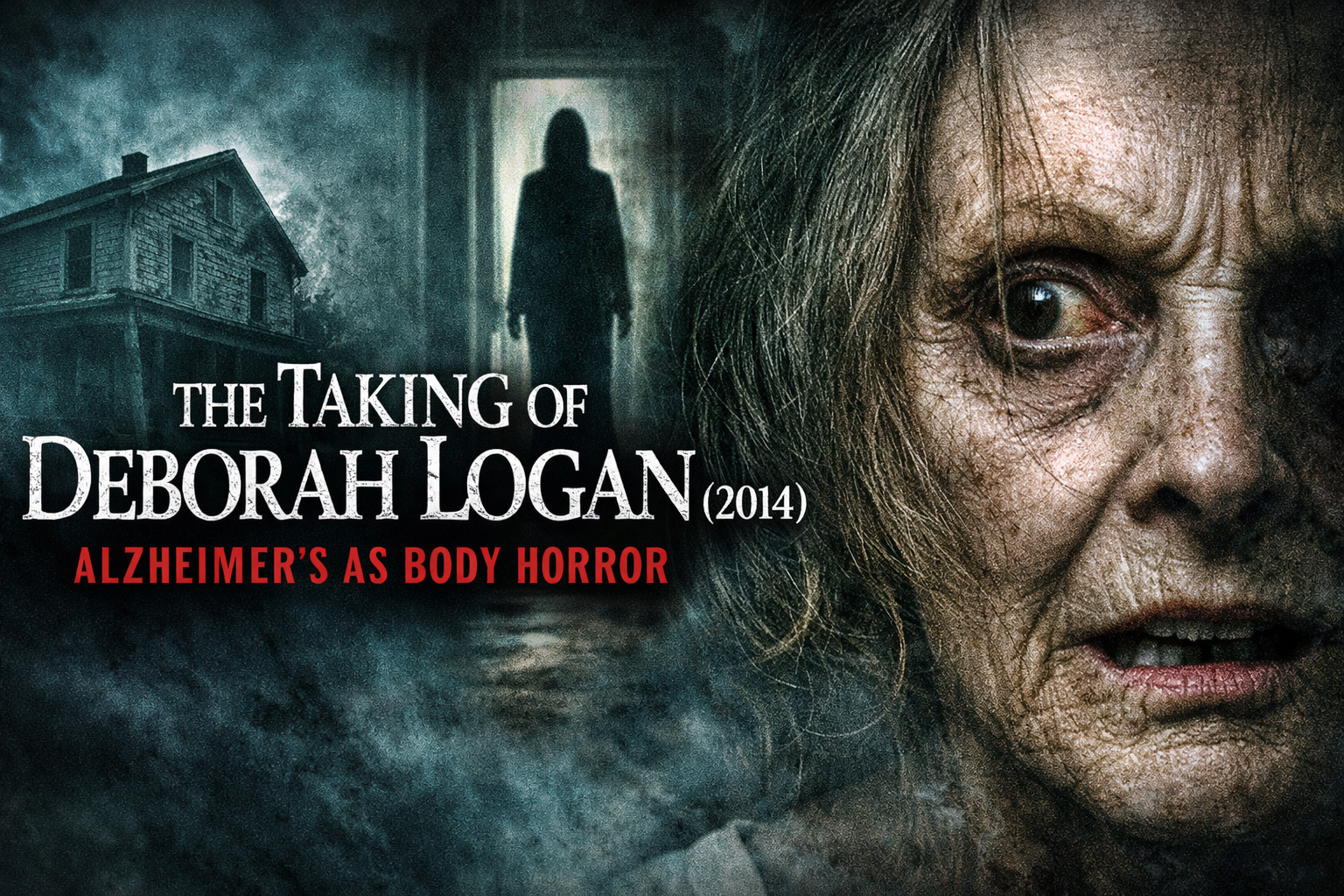
By the time The Taking of Deborah Logan appeared in 2014, found footage horror was already burdened with exhaustion. The form had been stretched thin by repetition and cheap escalation, its once-radical intimacy dulled by predictability. And yet, this film arrived quietly and stayed. It did not announce itself with spectacle or reinvention, but with patience—allowing dread to seep in through mundane observation, medical documentation, and the unglamorous terror of watching a mind erode.
Often cited in discussions of underrated horror cinema, The Taking of Deborah Logan endures because it understands that true fear is not loud. It is procedural. It is incremental. It lives in the subtle betrayal of the body by the self, and in the suggestion that something ancient and unyielding may be waiting beneath familiar diagnoses. As a found footage horror film, it disguises its ambitions behind realism, only to reveal something far older and more malignant than its surface narrative suggests.
At its core, this is a film about Alzheimer’s as body horror—about the fragility of identity and the terror of watching consciousness dissolve. But it is also a work of religious horror, steeped in questions of belief, inevitability, and the terror of discovering that faith arrives too late to be useful. This The Taking of Deborah Logan review examines why the film remains so effective years after its release, and why its quiet confidence continues to unsettle modern horror audiences.
Plot Overview
The film follows a small documentary crew granted access to Deborah Logan, an elderly woman diagnosed with Alzheimer’s disease, and her daughter Sarah, who has agreed to let the progression of the illness be filmed for academic purposes. The project is framed as a clinical study—observational, detached, and ostensibly humane.
As filming continues, Deborah’s condition worsens in ways that strain medical explanation. The crew documents behavioral changes, memory loss, and disorientation, but also moments that suggest something less comprehensible at work. The narrative unfolds through interviews, night recordings, and observational footage, maintaining the illusion of a grounded, investigative documentary even as the boundaries between illness and intrusion begin to erode.
The film avoids sensational plot turns in favor of accumulation. Each recorded moment builds upon the last, allowing the viewer to remain inside the process rather than outside it. The horror emerges not from surprise, but from recognition.
Horror Style & Themes
What distinguishes The Taking of Deborah Logan from many of its contemporaries is its restraint. Fear is constructed through absence as much as presence—through long stretches of quiet observation punctuated by moments of behavioral rupture. Sound design favors domestic ambience over orchestration. The camera lingers when it should look away. Silence becomes accusatory.
Alzheimer’s is not treated as a metaphor lightly applied, but as an existential condition that mirrors the film’s deeper anxieties. Deborah’s deterioration reflects a broader horror: the loss of narrative coherence itself. As memory fails, time becomes unreliable. Identity fractures. The viewer is forced to confront a reality where continuity is not guaranteed, and where the self may simply disintegrate without meaning or closure.
The film’s religious horror elements arrive gradually, rooted in the language of possession, ritual, and inherited guilt. Faith is not presented as salvation, but as a system struggling to impose order on something indifferent to human belief. This places the film at an intersection between psychological horror and cosmic horror, where ancient forces are less interested in humanity than in their own persistence.
There is no comfort offered in diagnosis, nor in belief. Knowledge does not protect. Documentation does not save. The horror is not merely that something is happening to Deborah Logan, but that it may have always been waiting.
Found Footage Effectiveness
The found footage format is essential to the film’s impact because it enforces limitation. The camera does not intervene; it records. It cannot interpret, only observe. This creates an ethical tension that becomes increasingly uncomfortable as events escalate. The audience is implicated as a witness, complicit in the act of watching deterioration unfold for the sake of understanding.
Authenticity is achieved not through chaos, but through procedure. Interviews are mundane. Equipment fails quietly. Conversations overlap. The footage feels less like a horror film and more like evidence, which lends the later developments an unsettling plausibility. The implication is not that the camera reveals truth, but that it captures fragments—never enough to prevent what is coming.
In this way, The Taking of Deborah Logan uses found footage not as a gimmick, but as a philosophical constraint. Horror exists precisely because the format cannot offer omniscience or control.
Ending Explained — Meaning, Symbolism, and Implications
The ending of The Taking of Deborah Logan is often discussed for its shift in scale, but its true significance lies in culmination rather than surprise. What is revealed is not a narrative reversal, but a clarification: the personal horror of Deborah’s decline has always been tethered to something impersonal and ancient.
Symbolically, the conclusion reframes Alzheimer’s not as a misdirection, but as a vulnerability—an opening through which something inhuman can assert itself. The film suggests that loss of self is not merely tragic, but dangerous. When identity erodes, it creates space for occupation, not redemption.
From a cosmic horror perspective, the ending reinforces the idea that human suffering is incidental to larger forces. The rituals, the names, and the history uncovered near the film’s conclusion do not offer mastery over evil, only a vocabulary for its presence. Knowledge arrives too late, and faith is exposed as reactive rather than preventative.
Rather than resolving fear, the ending removes illusion. It implies that horror is not an interruption of normality, but an extension of it—waiting patiently for weakness.
Final Verdict / Why It Endures
The Taking of Deborah Logan is a film for viewers who value atmosphere over excess, implication over spectacle. It speaks to horror fans drawn to found footage not for chaos, but for intimacy; to audiences unsettled by the slow violence of time and the unreliability of the self.
Its legacy lies in its seriousness. The film does not mock belief, nor does it romanticize suffering. Instead, it presents horror as an inevitable convergence of biology, history, and indifference. In an era saturated with self-aware genre exercises, this film remains unsettling because it never winks.
Long after the footage ends, what lingers is not the image of possession, but the quiet terror of watching a person disappear—knowing that something else may be waiting to take their place.